Community Supported Agriculture (CSA) represents a partnership between farmers and community members where families purchase shares of a farm’s harvest in advance, providing farmers with upfront capital while guaranteeing fresh, seasonal produce throughout the growing season. At Food Farm Gardens, we’ve reimagined this traditional model to reflect Caribbean values, heritage preservation, and community resilience.
Our CSA program transforms the conventional farmer-consumer relationship into something deeper: heritage stewardship through shared abundance. When you join FFG’s CSA, you’re not just buying vegetables—you’re investing in Caribbean food sovereignty, supporting heritage preservation at Plantation Succour, and participating in a community-driven economic model that keeps wealth circulating within our region.
The FFG Approach: Heritage-Rooted, Community-Centered
What sets FFG’s CSA apart is our integration of 300+ years of Caribbean agricultural heritage with modern sustainable farming practices. Every CSA box tells a story—not just of the crops inside, but of the hands that planted them, the heritage walls that frame the gardens, and the community that makes it all possible.
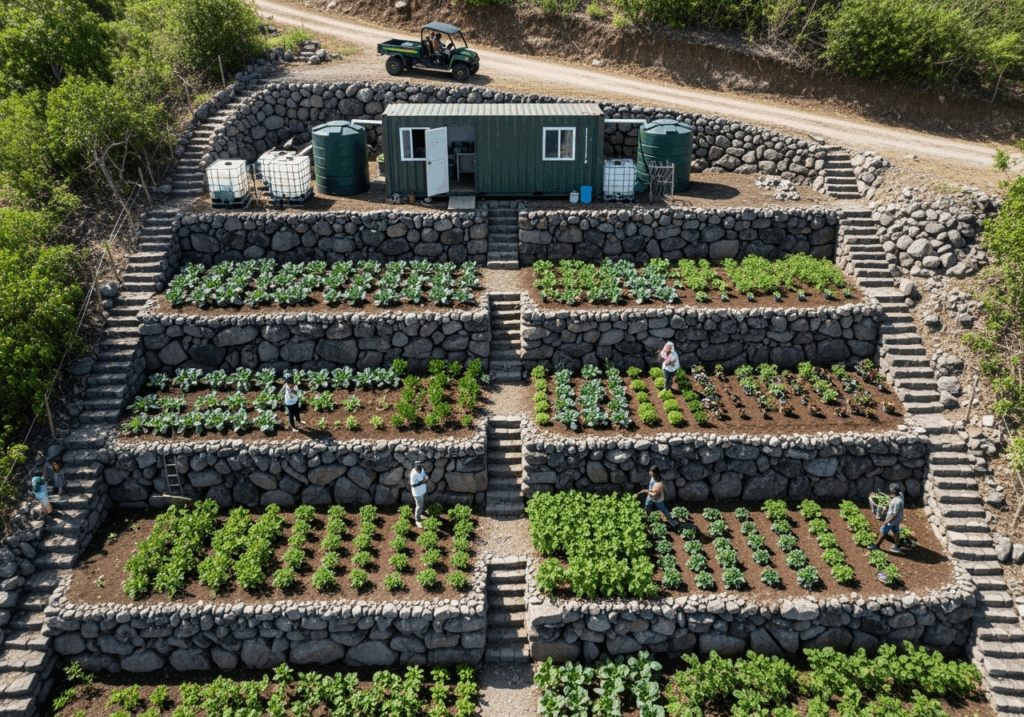
Our approach begins with terraced heritage gardens at Plantation Succour, where CSA crops grow alongside Community Gardens plots in a landscape shaped by centuries of Caribbean agricultural wisdom. The same stone walls built by enslaved ancestors now support a thriving food system that prioritizes community ownership over corporate profit.
Seasonal abundance drives our CSA model rather than year-round uniformity. Caribbean growing seasons offer incredible diversity—from drought-resistant root vegetables during dry months to lush greens during rainy season. Our CSA members experience this natural rhythm, connecting with the land’s cycles while enjoying peak-season flavors that supermarket produce simply cannot match!
Community participation extends beyond receiving weekly boxes. CSA members are invited to heritage tours, seasonal planting workshops, and harvest celebrations that strengthen social bonds while deepening understanding of sustainable agriculture. This isn’t just food delivery—it’s community building through shared meals and shared values.
Our CSA program operates as part of FFG’s dual-structure approach, where community impact and economic sustainability reinforce each other. CSA revenue supports Community Gardens infrastructure, funds HAICI School educational programs, and provides stable income for local farmers while keeping food dollars circulating within our Caribbean community.
CARET token integration allows CSA members to earn cryptocurrency rewards for participation, referrals, and community engagement. These tokens can be used for membership renewals, market purchases, or saved as investment in Caribbean sustainable development. This creates a closed-loop economy where food purchases become community investment.
The Keys Market connection means CSA members receive priority access to additional local products, seasonal specialties, and value-added goods like preserves, spices, and traditional Caribbean preparations. CSA boxes become the foundation for broader local food system participation.
Educational component through HAICI School ensures CSA members understand not just what they’re eating, but how it’s grown, why certain crops are chosen, and how their participation supports broader Caribbean food sovereignty goals. Monthly newsletters include recipes, growing tips, and stories from the farmers who grew their food.
Organic certification standards guide all CSA production, ensuring members receive food free from synthetic pesticides, herbicides, and chemical fertilizers. But our commitment goes beyond organic—we prioritize regenerative practices that improve soil health, support biodiversity, and build climate resilience.
Seasonal crop planning maximizes nutritional value and flavor while working with Caribbean climate patterns rather than against them. Our CSA boxes celebrate abundance when crops are at their peak rather than forcing year-round availability that compromises quality and sustainability.
Local variety preservation means CSA members regularly receive heritage Caribbean vegetables, traditional medicinal plants, and culturally significant crops that connect them to their agricultural roots. We’re not just growing food—we’re preserving genetic diversity and cultural knowledge for future generations.
Transparent pricing ensures members understand exactly how their CSA investment supports farmer livelihoods, infrastructure maintenance, and community programs. No hidden fees, no corporate markups—just honest pricing that reflects the true cost of sustainable, community-centered agriculture.
FFG’s CSA program represents more than convenient food delivery—it’s a practical step toward Caribbean food sovereignty. Every CSA share purchased reduces dependence on imported produce, supports local farmers, and builds community resilience against supply chain disruptions.
Economic impact extends beyond individual households to strengthen the entire local food system. CSA revenue provides farmers with predictable income, funds infrastructure improvements, and creates employment opportunities for community members interested in sustainable agriculture careers.
Cultural preservation happens naturally as CSA members reconnect with traditional Caribbean foods, cooking methods, and seasonal eating patterns. Children grow up understanding where food comes from and how their choices impact their community’s wellbeing.
Climate resilience develops as our community becomes less dependent on long-distance food transportation and more connected to local growing conditions. CSA members learn to eat seasonally, preserve abundance, and appreciate the natural rhythms that sustainable agriculture requires.
As a CSA member, you become part of a heritage stewardship community committed to Caribbean food sovereignty. Your (bi)weekly box represents your investment in sustainable agriculture, your support for local farmers, and your participation in a food system that prioritizes community wellbeing over corporate profit.
Seasonal flexibility means some weeks bring abundant variety while others focus on storage crops and preserved goods. This reflects natural growing cycles and teaches appreciation for seasonal abundance rather than expecting uniform availability year-round.
Community engagement opportunities include farm visits, harvest volunteering, cooking workshops, and seasonal celebrations that strengthen bonds between CSA members and the farmers who grow their food. These connections create the social foundation for long-term food system resilience.
Feedback and participation help shape CSA offerings, influence crop selection, and improve delivery systems. This isn’t a corporate food service—it’s a community partnership where member input directly influences how the program evolves.
The Future of Caribbean Food Systems
FFG’s CSA program demonstrates that community-controlled food systems can provide economic opportunity, preserve cultural heritage, and build climate resilience simultaneously. As our program grows, we’re creating a replicable model for Caribbean food sovereignty that other communities can adapt to their specific contexts.
Regional expansion will connect CSA programs across Caribbean islands, creating networks of mutual support and knowledge sharing. Success in Sint Maarten becomes the foundation for broader Caribbean food system transformation.
Innovation integration through CARET tokens, digital platforms, and educational programs shows how traditional CSA models can evolve to meet contemporary needs while maintaining their community-centered values.
Heritage preservation ensures that as we build modern food systems, we honor the agricultural wisdom of our ancestors and preserve it for future generations. Our CSA program proves that looking backward and moving forward can happen simultaneously.
Join FFG’s CSA program and become part of the generation that transformed Caribbean food systems from dependence to sovereignty, from corporate control to community ownership, from imported uniformity to local abundance.